Lab 7: Spirometry
Preparation for lab
To get the most out of this lab you need to be prepared. The basic knowledge needed for this lab is covered in Amerman “Human Anatomy and Physiology” in Chapter 21.3 “Pulmonary Ventilation”.
Introduction
In this lab, you will investigate the volume of air that your lungs move as you breathe in and out. You will use a spirometer to directly measure air volume and also estimate lung volume and determine whether quick estimate agree with your direct measurements. By combining those measurements with the number of breaths you take per minute, you will figure out how much air moves in and out of your lungs over time. Finally, you will calculate the volume of oxygen (O₂) that you absorb and the volume of carbon dioxide (CO₂) that you produce. (note: 1000 ml = 1 liter, 1 ml = 0.001 liter)
Measuring Respiratory Volumes
The most important respiratory volumes that are of interest to physiologists and health professionals are:
-
Tidal Volume (TV)
-
Inspiratory capacity (IC)
-
Expiratory reserve volume (ERV)
-
Vital capacity (VC)
Because you can consciously control your breathing, one can use a spirometer to measure the lung volumes described above. Follow the instructions carefully, and repeat your measurements at least 3 times and average the values.
DIRECTIONS: The subject using the spirometer should stand facing away from the gauge, holding his/her nostrils closed while exhaling. Make the following measurements and record your values. Use units of liters. (Note: 1 L = 1,000 mL)
-
Tidal volume (TV): Inspire normally, then expire normally into the spirometer. The number on the gauge is your TV.
-
Inspiratory capacity (IC): Inspire maximally. Expire into the spirometer normally (do not force any air out). Record the volume shown on the gauge. This volume includes your TV, so subtract TV from this volume to get IRV. $IC - TV = IRV$
-
Expiratory reserve volume (ERV): Expire normally. Now, put the spirometer to your mouth and forcefully and completely expire the air that remains in your lungs. The number on the gauge is your ERV.
-
Vital capacity (VC): Inspire maximally. Now, expire forcibly and completely into the spirometer.
| Subject | TV | IC | IRV | ERV | VC | TV+IRV+ERV |
|---|---|---|---|---|---|---|
Estimating Vital Capacity
Directly measuring vital capacity can be a hassle. Also, VC is greatly influenced by how tall you are. For these reasons, physiologists often estimate VC using a person’s height: take the person’s height and multiply it by a conversion factor.
DIRECTIONS:
-
measure the subjects height (note: 1 inch = 2.54 cm = 25.4 mm)
-
Ladies: multiply your height (in cm) by 0.02 l/cm. Gentlemen: multiply your height by 0.025 l/cm.
Both: Record this value as VC estimate 1
-
Another way to estimate VC is to use a standardized chart. The chart provided in Figure 6.1 takes into account sex, height, and age. Look up the value and record it as VC estimate 2.
-
For comparison also record the VC you measured in the last section. How does it compare to the two estimates?
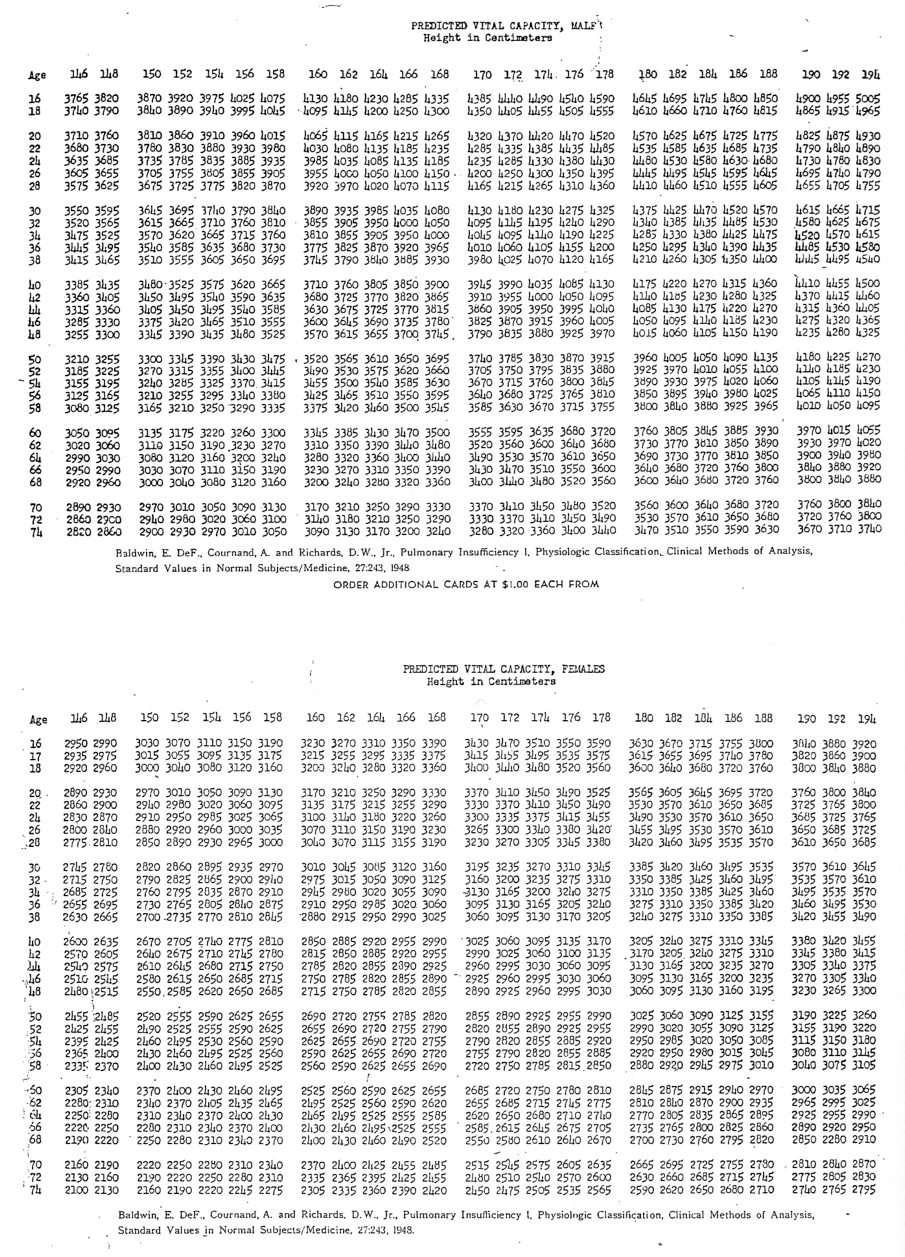
Find your height (cm) and your age (years), then triangulate to find your estimated VC (mL). If your age falls between lines (e.g.: age 19), average the VC values of the ages above and below yours. Do the same if your height falls between lines.
| Subject | VC estimate method 1 | VC estimate method 2 | VC measured |
|---|---|---|---|
Lung Ventilation
You know how much air you move with each breath (TV), but how much air do you move over longer periods of time?
-
Breathing rate: the number of breaths you take in one minute. While sitting quietly and watching a clock, count your breaths for one minute. Do this multiple times to get a more precise value. Record this value as “breathing rate”.
-
Respiratory minute volume (RMV): the volume of air that you breath in one minute. Since you have determined your breathing rate and tidal volume, you can calculate your RMV and record it. RMV = Breathing Rate x TV Not all of the air that you breath actually makes it to the alveoli in your lungs where gas exchange takes place. For example, the last bit of air that you inhale only makes it to your trachea before getting exhaled. With each breath, some of your tidal volume occupies these anatomical dead spaces, the air spaces of your respiratory tubes. Dead space is approximately 150 mL.
-
Pulmonary Ventilation (PV): the volume of air that actually reaches your alveoli. Calculate your PV and record it.
PV = Breathing Rate * (TV - Dead Space)
| Subject | Breathing Rate [breath / min] |
TV [L/breath] |
RMV [L/min] |
PV [L/min] |
|---|---|---|---|---|
You know how much air reaches your alveoli in a minute (PV). How much air do you respire . . .
per hour? per day? per week? per year?
Absorption and excretion of gases
You know how much air reaches your lungś alveoli each minute (PV), but how much Oxygen do you actually absorb into your body? Here is the percent amount of different gases in the air that enters your lungs and in the same air as it leaves your lungs.
| gas | inspired | expired |
|---|---|---|
| O2 | 20.9 % | 15.8 % |
| CO2 | 0.04 % | 4.0 % |
| N2 | 79.0 % | 79.0 % |
Above table shows that the air that you inhale is 20.9% oxygen. When you exhale that same air, only 15.8% of your breath is oxygen. On the other hand, 0.04% of the air you inhale is carbon dioxide, and when you exhale that same air, 4.0% of it is carbon dioxide The human body does not consume or produce nitrogen, so the percent of the air you inhale vs. exhale that is nitrogen remains unchanged at 79.0%.
Using the information in the table and your value for PV, how many mL of oxygen do you absorb per breath? Carbon-dioxide is a major greenhouse gas - and you produce a little bit of it with every breath. How much? Using the information in the table and your value for PV to calculate how much CO₂ you produce through breathing every minute.
A few last things that will help for the lab assignment.
-
You absorb some amount of oxygen in mL per breath. If you know your breathing rate, you know how much oxygen you absorb per minute.
-
1 liter CO₂ gas equals 0.0000018322003083900225 metric tons at room temperature.
Setup & supplies
For each table
-
Spirometer
-
2 ga water